June 15, 2026
Development and Validation of Velocity-Intensity Correlation for Shot Peening Media Using Shotmeter G3
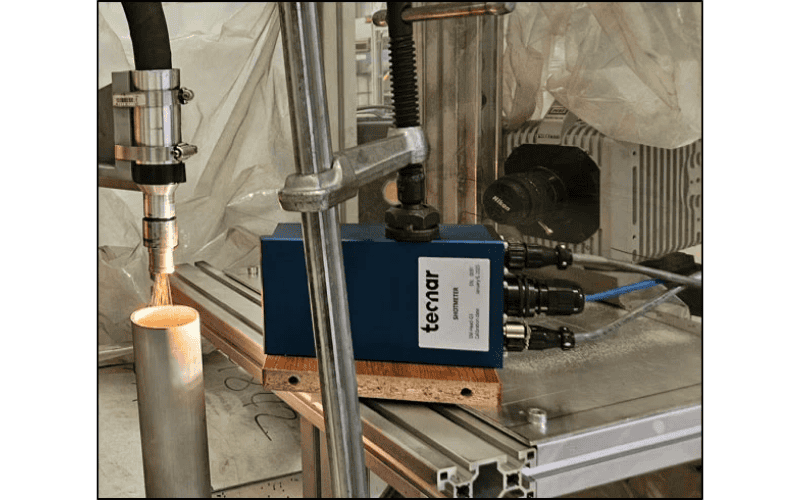
Repeatable and accurate shot peening results rely on closed-loop monitoring and control of critical process parameters. Fundamentally, the transfer of energy during shot peening can be summarized into a simple equation relating mass of the peening media and velocity of impact (1/2 x mass x velocity2). Assuming that constant mass of peening media particles is maintained using a vibratory classifier and regular inspections, velocity becomes a key factor that will influence the intensity. Therefore, it becomes imperative that we understand the relationship better and possibly arrive at a desired level of predictability. Our research project identified three media sizes/types, S-550, 1/8” steel balls and CCW-28 to study the relationship. This data-driven approach to corelate shot velocity with peening intensity was carried out using a robotic shot peening cell equipped with a Tecnar Shotmeter G3 and Photron FastCam. We derived polynomial and linear regression models to predict intensity from velocity measurements through a custom-developed application. Traditionally, intensity is calculated through a saturation curve that is generated by a minimum of four data points and then verified periodically, pre-process using Almen strips. This introduces delays and increases the possibility of variability. Our project addresses the need for real-time intensity estimation by leveraging velocity measurements from different types of sensors and correlating them to Almen intensity values.
Originally published at The Shot Peener (May 8, 2026)
By Gioacchino Salvagio, Khaled Tlili, and Christopher Bousquet-Jetté